Article: How to choose blinds for your home: the complete guide for beginners

How to choose blinds for your home: the complete guide for beginners
Introduction: Why choosing blinds isn't as easy as it seems
Working with clients on a daily basis, I see the same situation: a person comes in with the thought "I need blinds," but after 5 minutes realizes that the choice is not that simple.
There are dozens of types, fabrics, mechanisms, assembly options, and technical nuances to consider.
To make the choice easier, I always start with a few simple questions that immediately set the right direction.
Step 1 - In what room will the blinds be used?
Different spaces = different requirements:
• Bedroom → important blackout, morning sun, sleep quality
• Living room → design, light control, comfort
• Kitchen → moisture, grease, easy care
• Offices / work spaces → glare on the screen, daylight regulation
• Balcony door → blinds must not interfere with opening
• Bathroom → moisture-resistant materials
This first step already eliminates half of the unsuitable options.
Step 2 - Will there be a day curtain?
This is one of the most important questions I ask clients.
If there is a day curtain:
Then we look at all the blinds that attach to the window frame, because the curtain covers the rest.
Suitable solutions:
• day-night mini roller blinds
If there is no day curtain:
Then blinds should also be an interior element, not just a functional solution.
Suitable solutions:
• vertical blinds (especially for large rooms)
• day-night cassette blinds (for the kitchen)
• day-night roller blinds (very nice for rooms)
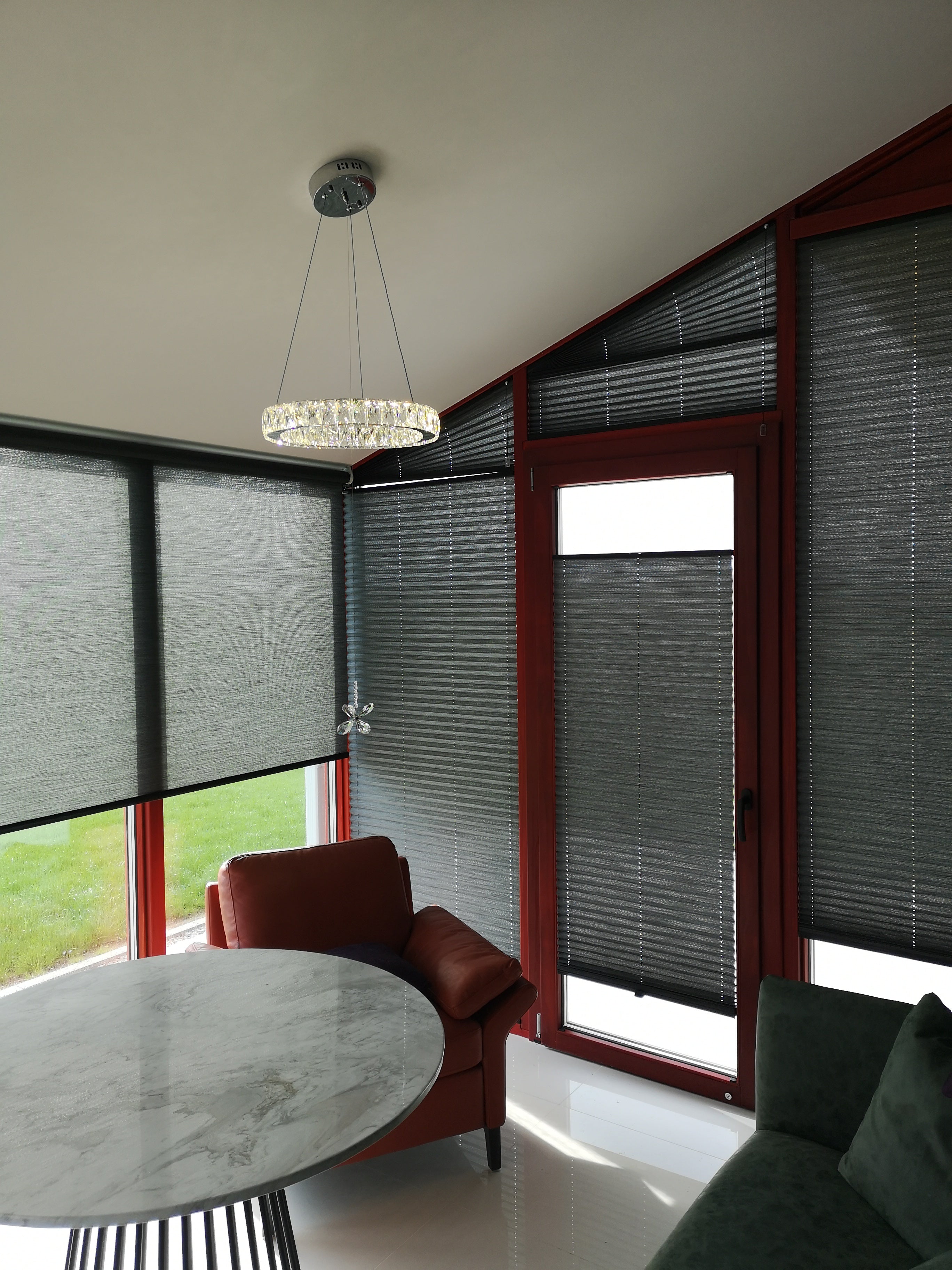
• pleated blinds (ideal for balcony doors)
Step 3 - Is the sun bothering you? And at what time of day?
This question is critically important because it is the intensity and direction of the sun that determines the choice of fabric.
If the sun doesn't bother you:
You can choose any fabric by color and design.
If the morning sun bothers you:
• ideal blackout fabrics,
• especially for small children's rooms,
• helps create a dark environment for sleep.
If the daytime sun bothers you:
Blackout will be too dark, so it's better to choose:
• sun-reflective fabrics,
• screen type fabrics,
• day-night fabrics with blackout dense stripes.
They reduce the impact of direct rays on surfaces, but retain light in the room.
Step 4 - Window technical details (very important!)
This is where what most clients don't know, but you know perfectly well, begins.
1) Does the window have a glass strip with a shallow depth?
If the strip is shallow, for example, for triple-glazed windows:
• pleated blinds require a depth of 1 cm,
• if not enough → use brackets,
• cassette blinds and day-night cassette blinds most often cannot be installed, they are replaced by mini roller blinds or day-night mini roller blinds
• horizontal 25 mm slats may not have enough space for turning → 16 mm slats are better.
2) Is there a bay wall near the window or balcony door?
Cassette blinds and mini roller blinds can interfere with opening.
Then the ideal solution is:
• pleated blinds,
• horizontal blinds,
• vertical or roller blinds, which are installed above the window (this will not be convenient for a balcony door)
3) Is the window a balcony door?
Best solutions:
• pleated blinds,
• horizontal blinds
Step 5 — choose the type of blinds according to the situation
Here is a short, customer-friendly guide:
Bedroom
• day-night rolls with dense bands
Kitchen
• cassette day–night (grease settles on the cassette, not the fabric)
• horizontal aluminum
Living room
• blinds on the window frame (cassette, mini-roller, pleated) - if there is a day curtain
• day-night roller blinds (nice, minimalist) - if there are no curtains
• vertical for large spaces
Balcony door
• pleated blinds (the best solution)
Children's room
• blackout roller
• day–night with dense bands
• pleated blackout
Step 6 - Color and Design
Once the technicalities are clear, all that's left is:
• choose a color,
• invoice,
• light transmission,
• how the blinds will fit into the interior.
This is where customers usually relax — because the choice becomes enjoyable.
Conclusion: Why this guide works
This method is based on real work with clients.
It helps:
• quickly understand needs,
• exclude unsuitable options,
• choose the technically correct solution,
• and finally - find beautiful, functional and long-lasting blinds.